
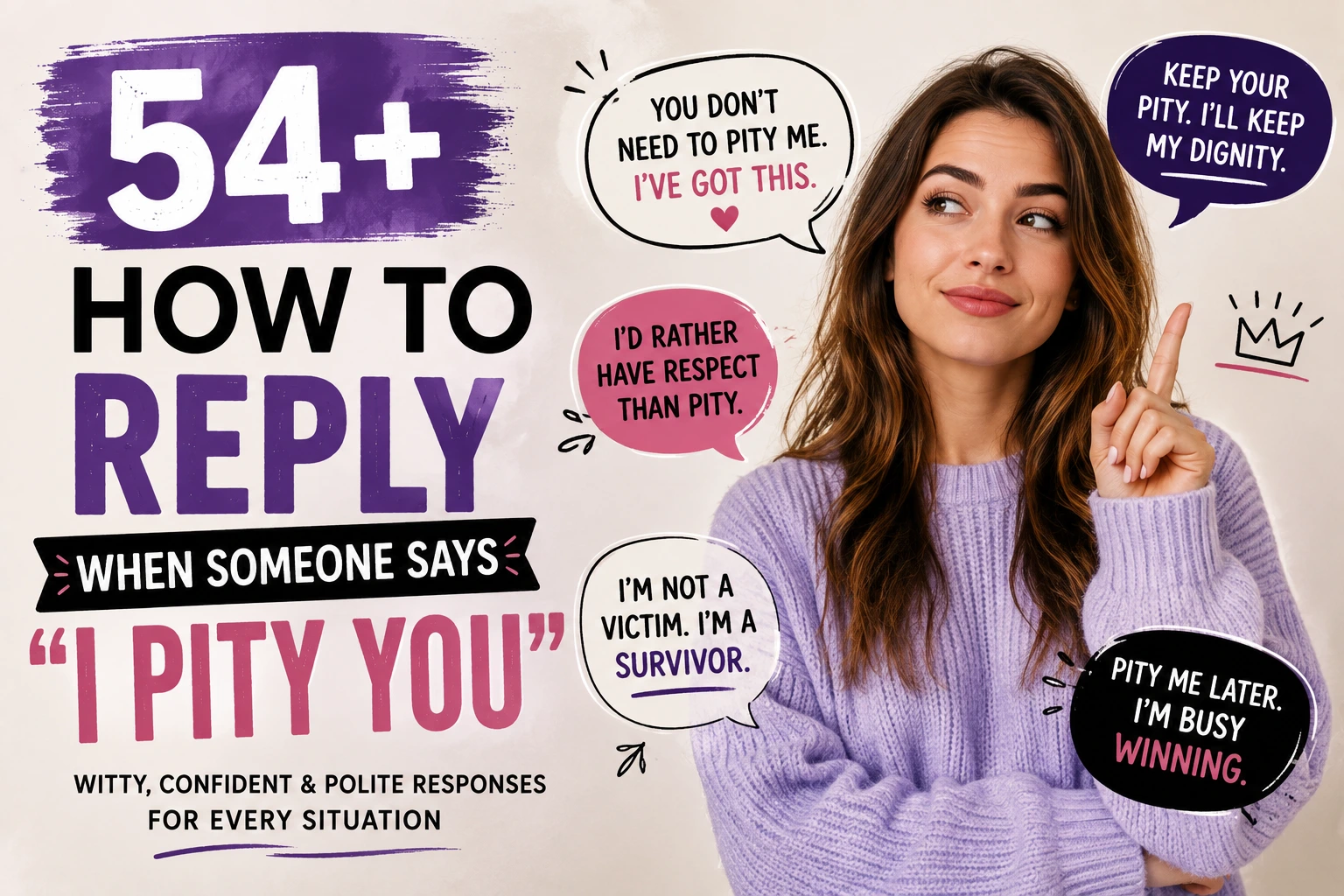
Hearing someone say “I pity you” can be uncomfortable, especially when their words sound condescending rather than compassionate. Your response can determine whether the conversation becomes awkward, confrontational, or surprisingly lighthearted. Knowing how to reply when someone says “I pity you” gives you the confidence to protect your dignity without losing your composure. Depending on the situation, you might respond with humor, quiet confidence, clever sarcasm, or firm boundaries. Sometimes the best answer is a calm reminder that you do not need anyone’s pity. In other moments, a witty comeback can instantly shift the mood. Creative alternatives make communication more personal because they allow you to respond according to your personality and relationship with the speaker. This guide presents thoughtful, confident, funny, and sophisticated responses for different situations, helping you choose words that communicate strength without unnecessary hostility.
What Does “How to Reply When Someone Says I Pity You” Mean?
“How to reply when someone says I pity you” refers to finding an appropriate response when another person expresses pity toward you.
The phrase “I pity you” generally means “I feel sorry for you.” However, its emotional meaning depends heavily on the speaker’s tone and intention. It can sometimes be genuinely sympathetic, but it may also sound patronizing, dismissive, or superior.
For example, someone might say:
“I pity you for having to deal with that.”
If they mean it kindly, a gracious response may be appropriate. If they are trying to belittle you, a confident response can establish a clear boundary.
Your reply should therefore reflect the situation. You can be polite, witty, sarcastic, assertive, or completely uninterested in the comment.
When to Use These Replies
The right response depends on who said “I pity you,” what they meant, and how comfortable you are with the conversation.
When Someone Is Genuinely Sympathetic
If the person is expressing sincere concern, you do not necessarily need a sharp comeback.
“I appreciate your concern, but I’m handling things quite well.”
When Someone Sounds Condescending
If their comment feels insulting, confidence is often more effective than anger.
“You don’t need to pity me. I’m perfectly capable of handling my situation.”
When a Friend Is Teasing You
A playful response can keep the conversation entertaining.
“Save your pity. I’m doing better than you think.”
When You Want to Use Humor
Humor can defuse an awkward moment.
“Thank you for your concern. Where should I collect my sympathy award?”
In a Professional Setting
Keep the response composed and respectful.
“I appreciate your concern, but I am comfortable managing the situation myself.”
In Text Messages
A short response can be more effective than a long explanation.
“Pity isn’t necessary. I’m good.”
During an Argument
Avoid escalating the situation unnecessarily.
“You can keep the pity. I prefer respect.”
Is It Polite or Professional?
The phrase “I pity you” can be polite when it comes from genuine sympathy, but it can also sound patronizing depending on the context. Because of this, your response should match the speaker’s intention.
In professional environments, calm and measured responses are usually better than sarcasm. If someone says something that feels disrespectful, you can acknowledge their concern while making your position clear.
For example:
“I appreciate your concern, but I would prefer to discuss the situation constructively.”
With close friends, humor and playful sarcasm may be completely appropriate.
The most effective response is one that preserves your self respect without creating unnecessary conflict. Confidence does not require aggression. Sometimes a calm sentence communicates far more strength than an angry comeback.
1. “You Don’t Need to Pity Me.”
Meaning: You are confident that you can handle your circumstances.
Tone: Calm and assertive.
“You don’t need to pity me. I’m perfectly capable of handling my situation.”
Why to use it: Use this when you want to establish a straightforward boundary without being rude.
Purpose and Personalization: This response works well when you prefer clarity over sarcasm.
2. “Save Your Pity for Someone Who Needs It.”
Meaning: You do not believe you require sympathy.
Tone: Confident and slightly sharp.
“Save your pity for someone who actually needs it.”
Why to use it: Useful when the other person’s comment feels patronizing.
Purpose and Personalization: It communicates independence without requiring a lengthy explanation.
3. “I Prefer Respect Over Pity.”
Meaning: You would rather be treated as an equal.
Tone: Mature and powerful.
“I appreciate concern, but I prefer respect over pity.”
Why to use it: Excellent when you want to respond with dignity.
Purpose and Personalization: This is especially effective when the conversation has become disrespectful.
4. “I’m Not Looking for Sympathy.”
Meaning: You do not want pity from the other person.
Tone: Direct and composed.
“I’m not looking for sympathy. I’m simply dealing with what happened.”
Why to use it: Perfect when you want to shut down unnecessary sympathy.
Purpose and Personalization: It keeps the conversation focused on reality rather than emotion.
5. “I’m Doing Just Fine.”
Meaning: You are assuring the person that you are okay.
Tone: Calm and confident.
“I’m doing just fine, so there’s really no need to pity me.”
Why to use it: A simple response when you do not want confrontation.
Purpose and Personalization: Its understated confidence makes it versatile.
6. “Keep the Pity. I’ll Keep My Dignity.”
Meaning: You reject pity while emphasizing self respect.
Tone: Strong and assertive.
“You can keep the pity. I’ll keep my dignity.”
Why to use it: Effective when someone is deliberately trying to make you feel inferior.
Purpose and Personalization: A concise statement that creates a strong boundary.
7. “That’s Kind, but I Don’t Need It.”
Meaning: You acknowledge the gesture without accepting pity.
Tone: Polite and confident.
“That’s kind of you, but I don’t need your pity.”
Why to use it: Best when the person may not have intended to offend you.
Purpose and Personalization: This response leaves room for the possibility that their intentions were sincere.
8. “I’d Rather You Believe in Me.”
Meaning: You want encouragement instead of sympathy.
Tone: Positive and motivational.
“I’d rather you believe in me than pity me.”
Why to use it: Excellent when you want to redirect the conversation toward encouragement.
Purpose and Personalization: It transforms a negative comment into an opportunity for constructive communication.
9. “Pity Isn’t Really My Style.”
Meaning: You do not identify with being treated as helpless.
Tone: Casual and confident.
“Pity isn’t really my style, but thanks for the concern.”
Why to use it: A relaxed response when you want to avoid sounding confrontational.
Purpose and Personalization: Suitable for friends, acquaintances, and casual conversations.
10. “I’ll Be Fine Without the Sympathy.”
Meaning: You are confident in your ability to cope.
Tone: Firm and independent.
“I’ll be fine without the sympathy, honestly.”
Why to use it: Use this when you want to emphasize emotional independence.
Purpose and Personalization: It is especially effective when someone assumes you are incapable of managing difficulties.
11. “You Can Keep Your Pity.”
Meaning: You politely reject the other person’s sympathy.
Tone: Direct and slightly cold.
“You can keep your pity. I’m not interested in receiving it.”
Why to use it: Best when the comment was clearly disrespectful.
Purpose and Personalization: Keep your delivery calm so the response feels confident rather than hostile.
12. “I Don’t Need Anyone Feeling Sorry for Me.”
Meaning: You do not want to be viewed as helpless.
Tone: Assertive.
“I don’t need anyone feeling sorry for me. I’ll handle it.”
Why to use it: Good for situations where someone underestimates your resilience.
Purpose and Personalization: Communicates strength without attacking the other person personally.
13. “I’m Stronger Than You Think.”
Meaning: You believe you can overcome your circumstances.
Tone: Confident and motivational.
“You may pity me, but I’m stronger than you think.”
Why to use it: Excellent when someone has underestimated your ability to cope.
Purpose and Personalization: It turns their assumption into an opportunity to demonstrate confidence.
14. “Don’t Mistake My Situation for Weakness.”
Meaning: Difficult circumstances do not make you weak.
Tone: Powerful and assertive.
“Don’t mistake my situation for weakness. I know exactly how to handle it.”
Why to use it: Use this when pity is being used as a way to diminish you.
Purpose and Personalization: Particularly effective in serious conversations.
15. “I’m Not a Tragedy. I’m a Work in Progress.”
Meaning: You view challenges as part of personal growth.
Tone: Inspirational and confident.
“I’m not a tragedy. I’m simply a work in progress.”
Why to use it: A thoughtful response when you want to shift the conversation toward growth.
Purpose and Personalization: This works especially well when discussing personal challenges.
16. “Your Pity Is Unnecessary.”
Meaning: You do not require sympathy.
Tone: Formal and direct.
“Your pity is unnecessary, but I appreciate your concern.”
Why to use it: Suitable when you want to sound composed and mature.
Purpose and Personalization: Its formal wording can work in more serious conversations.
17. “I’d Rather Have Your Support.”
Meaning: You prefer encouragement to pity.
Tone: Warm and constructive.
“I’d rather have your support than your pity.”
Why to use it: Perfect when you want to preserve the relationship.
Purpose and Personalization: It tells the person exactly what kind of response would be more helpful.
18. “Pity Me Later. I’m Busy Winning.”
Meaning: You are focused on succeeding rather than feeling sorry for yourself.
Tone: Bold and playful.
“Pity me later. I’m a little busy proving everyone wrong.”
Why to use it: Great for a confident and slightly dramatic comeback.
Purpose and Personalization: Best suited to casual conversations and friendly banter.
19. “I’ll Take Encouragement Instead.”
Meaning: You prefer positive support.
Tone: Friendly and mature.
“Thanks, but I’ll take encouragement instead.”
Why to use it: Useful when the person may genuinely want to help.
Purpose and Personalization: It redirects the conversation without creating unnecessary tension.
20. “That’s an Interesting Perspective.”
Meaning: You acknowledge the comment without agreeing with it.
Tone: Polite and restrained.
“That’s an interesting perspective, although I don’t see myself that way.”
Why to use it: Excellent when you want to remain calm and avoid confrontation.
Purpose and Personalization: Particularly suitable for acquaintances or professional settings.
21. “I’m Sorry You See Me That Way.”
Meaning: You reject the negative perception without directly attacking the speaker.
Tone: Mature and composed.
“I’m sorry you see me that way, but I’m comfortable with where I am.”
Why to use it: Useful when the other person’s pity feels judgmental.
Purpose and Personalization: It shifts attention toward their perspective rather than accepting their judgment.
22. “That’s Quite a Dramatic Assessment.”
Meaning: You believe their pity is exaggerated.
Tone: Witty and sarcastic.
“That’s quite a dramatic assessment of my situation.”
Why to use it: Perfect when someone is making your circumstances sound worse than they are.
Purpose and Personalization: A sophisticated alternative to an openly confrontational comeback.
23. “I Think I’ll Survive.”
Meaning: You are confident you will get through the situation.
Tone: Dry and humorous.
“I appreciate the concern, but I think I’ll survive.”
Why to use it: Great when you want to lighten an uncomfortable moment.
Purpose and Personalization: Works especially well when the situation is not genuinely serious.
24. “No Need to Bring Out the Violin.”
Meaning: You think the pity is unnecessarily dramatic.
Tone: Funny and sarcastic.
“No need to bring out the violin. I’m actually doing pretty well.”
Why to use it: Use this with people who appreciate playful sarcasm.
Purpose and Personalization: It turns excessive sympathy into a humorous moment.
25. “I Didn’t Realize My Life Needed a Sympathy Audience.”
Meaning: You find their pity unnecessary.
Tone: Witty and sarcastic.
“I didn’t realize my life needed a sympathy audience.”
Why to use it: Effective when someone is being excessively dramatic about your situation.
Purpose and Personalization: Best reserved for casual conversations.
26. “Thanks, but I’m Not Accepting Pity Today.”
Meaning: You are playfully rejecting sympathy.
Tone: Funny and confident.
“Thanks, but I’m not accepting pity today.”
Why to use it: A lighthearted option that avoids unnecessary seriousness.
Purpose and Personalization: You can replace “today” with “this week” for added humor.
27. “I’ll Pass on the Pity.”
Meaning: You politely reject their sympathy.
Tone: Casual and concise.
“I’ll pass on the pity, thanks.”
Why to use it: Perfect for a quick response.
Purpose and Personalization: Its brevity makes it ideal for text messages.
28. “Pity Is Not on My Wishlist.”
Meaning: You have no interest in receiving sympathy.
Tone: Playful and clever.
“Pity is not on my wishlist, but encouragement would be appreciated.”
Why to use it: Great when you want humor without hostility.
Purpose and Personalization: Particularly effective with friends.
29. “I’m Doing Better Than Your Pity Suggests.”
Meaning: Their sympathy is unnecessary because you are doing well.
Tone: Clever and confident.
“I’m doing considerably better than your pity suggests.”
Why to use it: A polished response when someone has underestimated you.
Purpose and Personalization: It communicates confidence without becoming aggressive.
30. “You’re Giving Me Too Much Credit for Being Helpless.”
Meaning: You are capable of handling yourself.
Tone: Witty and assertive.
“You’re giving me far too much credit for being helpless.”
Why to use it: Excellent when someone mistakenly assumes you cannot cope.
Purpose and Personalization: A clever response that exposes the flaw in their assumption.
31. “I’m Not Looking for a Rescue Mission.”
Meaning: You do not need someone to save you.
Tone: Independent and confident.
“I appreciate the concern, but I’m not looking for a rescue mission.”
Why to use it: Good when someone treats you as though you are incapable.
Purpose and Personalization: Reinforces independence while remaining composed.
32. “I Can Handle My Own Plot Twist.”
Meaning: You can manage unexpected difficulties yourself.
Tone: Playful and confident.
“Life gave me a plot twist, but I can handle my own storyline.”
Why to use it: A creative response for casual conversations.
Purpose and Personalization: Makes resilience sound confident and entertaining.
33. “My Life Isn’t Asking for Your Pity.”
Meaning: You do not want sympathy from the speaker.
Tone: Firm and direct.
“My life isn’t asking for your pity. I’m simply living it.”
Why to use it: Suitable when you need to make a strong boundary clear.
Purpose and Personalization: Use it when softer wording has not worked.
34. “I Appreciate the Sentiment, but I’m Good.”
Meaning: You acknowledge their concern while declining sympathy.
Tone: Polite and casual.
“I appreciate the sentiment, but I’m good, honestly.”
Why to use it: Perfect when you do not want to hurt the person’s feelings.
Purpose and Personalization: This is one of the safest choices when their intention may be sincere.
35. “I’m Not as Fragile as You Think.”
Meaning: You believe you are more resilient than they assume.
Tone: Strong and confident.
“I’m not nearly as fragile as you seem to think.”
Why to use it: Appropriate when someone repeatedly underestimates you.
Purpose and Personalization: Communicates emotional strength without insulting the other person.
36. “I’ll Be the Judge of Whether I Need Pity.”
Meaning: You want to decide for yourself how you feel about your circumstances.
Tone: Assertive and independent.
“I’ll be the judge of whether I need pity, thank you.”
Why to use it: Best when someone is imposing an unwanted emotional judgment.
Purpose and Personalization: Strong wording that clearly establishes autonomy.
37. “I’d Rather Focus on Solutions.”
Meaning: You prefer practical help over sympathy.
Tone: Professional and constructive.
“I’d rather focus on solutions than spend time feeling sorry for myself.”
Why to use it: Excellent for workplace or serious conversations.
Purpose and Personalization: It redirects the conversation toward productive action.
38. “Let’s Keep the Conversation Constructive.”
Meaning: You want the discussion to remain productive.
Tone: Professional and composed.
“I appreciate your concern, but let’s keep the conversation constructive.”
Why to use it: Ideal when someone’s comment is becoming unnecessarily negative.
Purpose and Personalization: Particularly useful in workplace communication.
39. “I’m Looking for Perspective, Not Pity.”
Meaning: You want thoughtful advice rather than sympathy.
Tone: Mature and articulate.
“I’m looking for perspective, not pity.”
Why to use it: A sophisticated response when discussing a difficult situation.
Purpose and Personalization: It clearly communicates what kind of conversation you prefer.
40. “Your Sympathy Is Not Required.”
Meaning: You do not need their pity.
Tone: Formal and reserved.
“Your sympathy is not required, but I appreciate your concern.”
Why to use it: Suitable for formal or emotionally distant situations.
Purpose and Personalization: Its restrained language helps prevent escalation.
41. “I’ve Got This.”
Meaning: You are confident you can manage the situation.
Tone: Short and confident.
“I appreciate it, but I’ve got this.”
Why to use it: Perfect when you want to end the subject quickly.
Purpose and Personalization: Simple, positive, and difficult to misinterpret.
42. “I’ve Survived Worse.”
Meaning: You have overcome more difficult circumstances before.
Tone: Strong and resilient.
“I’ve survived worse, so I’m not too worried about this.”
Why to use it: Useful when someone assumes your current problem will overwhelm you.
Purpose and Personalization: Communicates experience and emotional resilience.
43. “I’m Still Standing.”
Meaning: You remain strong despite difficulties.
Tone: Powerful and motivational.
“You can pity the situation if you want, but I’m still standing.”
Why to use it: Excellent when you want to emphasize perseverance.
Purpose and Personalization: Particularly meaningful during challenging conversations.
44. “I’ve Got More Strength Than You’re Giving Me Credit For.”
Meaning: You believe the speaker underestimates you.
Tone: Confident and assertive.
“I’ve got more strength than you’re giving me credit for.”
Why to use it: Great when someone assumes you are incapable of coping.
Purpose and Personalization: A strong but respectful response.
45. “Pity Won’t Change Anything.”
Meaning: Sympathy is not useful for solving the situation.
Tone: Practical and mature.
“Pity won’t change anything, but constructive support might.”
Why to use it: Ideal when you want to move toward a practical solution.
Purpose and Personalization: This response encourages useful communication.
46. “I’m Choosing Progress Over Pity.”
Meaning: You prefer to focus on moving forward.
Tone: Motivational and confident.
“I’m choosing progress over pity because I have better things to focus on.”
Why to use it: Excellent for an inspirational response.
Purpose and Personalization: Works particularly well when discussing setbacks or personal growth.
47. “I Don’t Need a Pity Party.”
Meaning: You are not interested in feeling sorry for yourself.
Tone: Casual and humorous.
“No pity party necessary. I’m already figuring things out.”
Why to use it: Perfect for friends and informal conversations.
Purpose and Personalization: Keeps the response energetic and optimistic.
48. “Please Don’t Confuse Struggle With Defeat.”
Meaning: Experiencing difficulty does not mean you have failed.
Tone: Powerful and thoughtful.
“Please don’t confuse what I’m going through with defeat.”
Why to use it: A sophisticated response when someone mistakes difficulty for weakness.
Purpose and Personalization: Especially effective when you want to communicate resilience.
49. “I’m Learning From It, Not Losing to It.”
Meaning: You view difficulties as opportunities for growth.
Tone: Motivational and resilient.
“I’m learning from this experience, not losing to it.”
Why to use it: Great for responding to pity with a positive mindset.
Purpose and Personalization: Turns a potentially negative conversation into an empowering one.
50. “You’d Be Surprised What I Can Handle.”
Meaning: Your resilience is greater than the person realizes.
Tone: Confident and slightly mysterious.
“You’d be surprised what I can handle when I put my mind to it.”
Why to use it: Useful when you want to respond confidently without explaining yourself.
Purpose and Personalization: Leaves the conversation with a strong impression.
51. “I’m Not Asking to Be Saved.”
Meaning: You are capable of managing your own circumstances.
Tone: Firm and independent.
“I’m not asking to be saved. I’m simply working through it.”
Why to use it: Appropriate when someone becomes overly sympathetic or protective.
Purpose and Personalization: Reinforces independence while avoiding unnecessary hostility.
52. “Pity Me After I’ve Given Up.”
Meaning: You have no intention of giving up.
Tone: Bold and motivational.
“Pity me after I’ve given up, because I’m nowhere near that point.”
Why to use it: Excellent when you want to emphasize determination.
Purpose and Personalization: Strong choice for a confident comeback.
53. “I’d Rather Be Underestimated Than Underestimate Myself.”
Meaning: Other people’s opinions do not define your confidence.
Tone: Reflective and powerful.
“You can underestimate me if you want. I’d rather be underestimated than underestimate myself.”
Why to use it: Ideal when you want to respond with maturity and self belief.
Purpose and Personalization: This response works particularly well in meaningful conversations.
54. “Keep Watching. I’ll Be Fine.”
Meaning: You are confident that your future will prove your resilience.
Tone: Bold and composed.
“Keep watching. I’ll be fine, and I’ll probably surprise you.”
Why to use it: A confident closing response when someone has underestimated you.
Purpose and Personalization: Best delivered calmly because confidence speaks louder than anger.
55. “Your Pity Might Be Premature.”
Meaning: You believe your situation will improve.
Tone: Clever and confident.
“Your pity might be a little premature. I’m just getting started.”
Why to use it: Perfect when you want to answer with optimism and subtle humor.
Purpose and Personalization: A strong choice when you want to leave the other person curious about what comes next.
56. “I’ll Let My Results Answer That.”
Meaning: You prefer to prove yourself through actions.
Tone: Confident and sophisticated.
“You can pity me if you want. I’ll let my results answer that.”
Why to use it: Excellent when someone doubts your ability.
Purpose and Personalization: Especially powerful in professional or competitive situations.
57. “I Don’t Need Pity When I Have Perspective.”
Meaning: You understand your circumstances without feeling defeated by them.
Tone: Mature and thoughtful.
“I don’t need pity when I have perspective and a plan.”
Why to use it: Suitable for a sophisticated response to an insensitive comment.
Purpose and Personalization: Shows emotional maturity while maintaining confidence.
58. “I’m Too Busy Building My Way Forward.”
Meaning: You are focused on progress rather than sympathy.
Tone: Motivational and confident.
“I’m too busy building my way forward to worry about being pitied.”
Why to use it: Perfect when you want to end the conversation on an empowering note.
Purpose and Personalization: A strong response for personal, academic, or professional situations.
59. “If You Want to Help, Believe in Me.”
Meaning: You would appreciate confidence and encouragement rather than pity.
Tone: Sincere and powerful.
“If you really want to help, believe in me instead of pitying me.”
Why to use it: Excellent when you want to turn an insensitive remark into a constructive conversation.
Purpose and Personalization: This response works particularly well with someone whose support genuinely matters to you.
60. “I’m Doing My Best, and That’s Enough.”
Meaning: You accept your efforts without needing external pity.
Tone: Calm and self assured.
“I’m doing my best, and that’s enough for me.”
Why to use it: A peaceful response when you do not want to argue.
Purpose and Personalization: Ideal when your priority is emotional composure rather than winning the conversation.
Conclusion
Knowing how to reply when someone says “I pity you” can help you handle an uncomfortable comment with confidence, humor, and emotional intelligence. The best response depends on the speaker’s intention and your relationship with them. You can choose a calm statement when you want to preserve peace, a witty comeback when the situation is casual, or a firm boundary when the comment feels disrespectful. The strongest responses do not require aggression. They simply communicate that your circumstances do not define your worth or ability. Choose words that feel authentic to you, remain composed, and remember that confidence often makes the most powerful reply.
Discover more
how to reply to happy holidays