
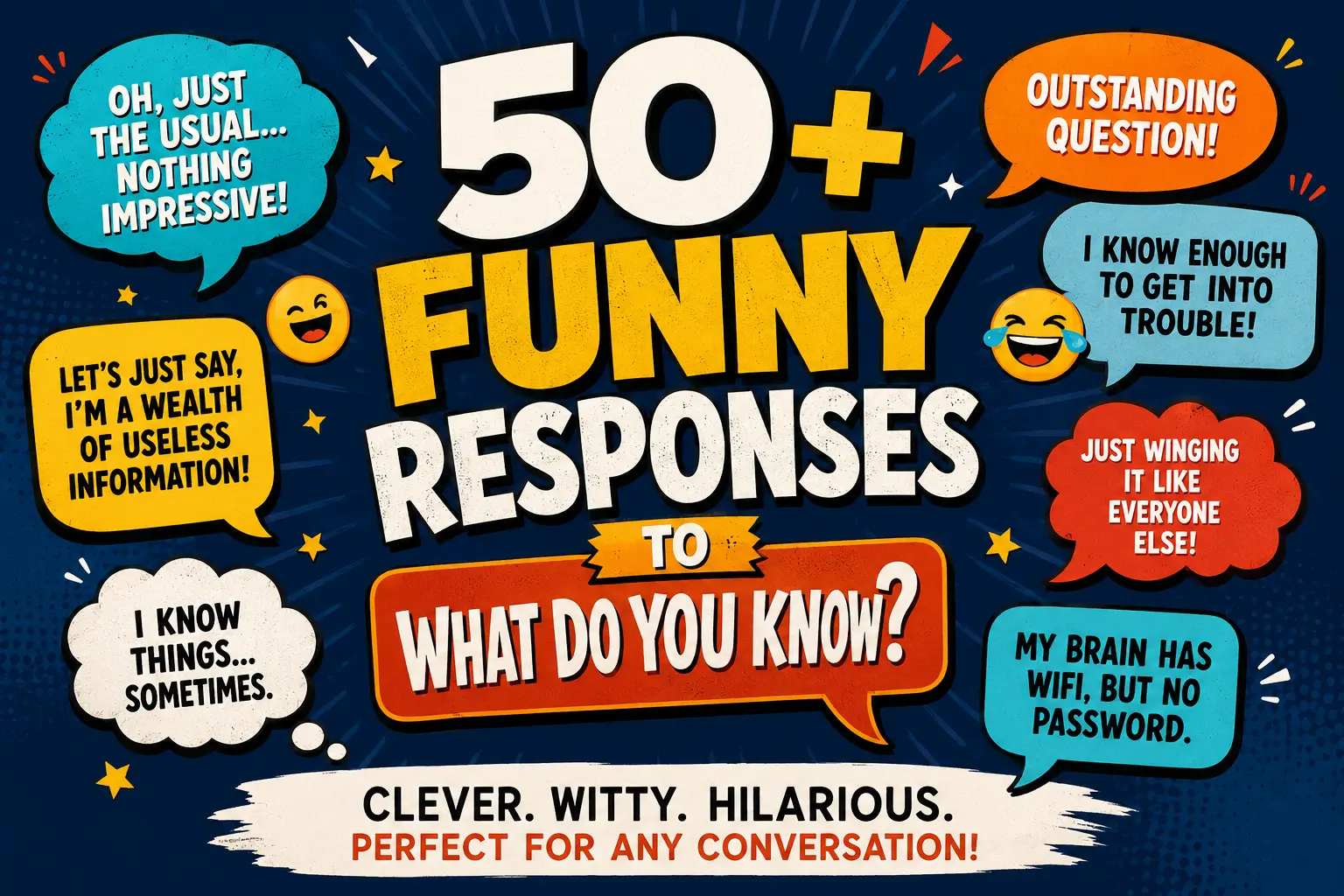
Sometimes, “What do you know?” is a genuine question, but sometimes it is an invitation to be clever. Whether someone is testing your knowledge, teasing you, starting a conversation, or simply being curious, a witty response can instantly make the interaction more entertaining. Instead of replying with a predictable “I know a lot,” you can use humor, sarcasm, confidence, or playful exaggeration to keep the conversation interesting. The best funny responses to “What do you know?” depend on your relationship with the person and the mood of the conversation. A clever comeback can make friends laugh, add personality to casual chats, or turn an ordinary exchange into memorable banter. In this guide, you will find more than 50 creative responses, along with explanations of when to use each one and what kind of tone it creates.
What Does “Funny Responses to What Do You Know?” Mean?
“What do you know?” can have several meanings depending on the context and tone.
Someone may genuinely be asking about your knowledge, challenging you to explain something, teasing you, or inviting you to share an interesting fact. In casual conversations, the question can also be rhetorical or playful.
Funny responses turn this straightforward question into an opportunity for humor. Instead of providing a serious answer, you can respond with sarcasm, exaggeration, clever wordplay, or unexpected confidence.
For example, saying “Enough to know I should probably Google the rest” creates a humorous and relatable response without taking the question too seriously.
When to Use Funny Responses to “What Do You Know?”
Funny responses work best in informal conversations where humor is welcome.
With Friends
Friends are usually the easiest people to joke with.
“Enough to be dangerous, not enough to be responsible.”
During Casual Texting
A witty response can make an ordinary text conversation more entertaining.
“I know things, but I’m not authorized to discuss them.”
When Someone Is Teasing You
A playful comeback can keep the teasing friendly.
“More than I’m willing to admit without legal representation.”
On Social Media
Short and clever responses work well in comments and casual interactions.
“I know what the internet told me five minutes ago.”
With Classmates or Coworkers
Light humor can work when you already have a comfortable relationship.
“I know enough to survive the meeting.”
When Not to Use Them
Avoid sarcastic or overly cheeky responses when speaking to a manager, client, interviewer, teacher, or someone you do not know well. In formal settings, a direct and respectful answer is usually better.
Is It Polite or Professional?
“What do you know?” itself is not necessarily rude or unprofessional. Its meaning depends heavily on context, facial expression, and tone.
Funny responses are generally better suited to friends, family members, classmates, and casual acquaintances. Some witty responses can also work among coworkers when the workplace culture is relaxed.
However, sarcasm can easily be misunderstood in professional communication, particularly through email or text. A response that sounds hilarious to a close friend might sound dismissive to a manager or client.
When in doubt, choose gentle humor rather than an aggressive comeback. The goal is to make the conversation more enjoyable, not to embarrass the other person.
1. “Enough to Get Me Into Trouble”
Meaning: You jokingly suggest that your knowledge can cause problems.
Tone: Playful and mischievous.
“What do I know? Enough to get me into trouble.”
Why to use it: Perfect for a friend who is asking in a teasing way.
2. “I Know More Than My Search History Suggests”
Meaning: You humorously imply that your knowledge is greater than your online searches suggest.
Tone: Witty and self deprecating.
“I know plenty, although my search history may disagree.”
Why to use it: Great for casual online conversations.
3. “Classified Information”
Meaning: You pretend your knowledge is confidential.
Tone: Mysterious and funny.
“What do I know? Classified information. Nice try.”
Why to use it: Use this when you want to create playful mystery.
4. “I Know Things. Many Things.”
Meaning: You exaggerate your knowledge for comedic effect.
Tone: Confident and humorous.
“I know things. Many things. Some of them are even useful.”
Why to use it: Works especially well when someone is playfully challenging you.
5. “Enough to Pass the Vibe Check”
Meaning: You jokingly claim to have sufficient knowledge without being an expert.
Tone: Casual and modern.
“I may not know everything, but I know enough to pass the vibe check.”
Why to use it: A fun choice for relaxed conversations.
6. “I Know What I Need to Know”
Meaning: You humorously avoid revealing details.
Tone: Confident and mysterious.
“I know what I need to know, and that is all you are getting.”
Why to use it: Good for playful arguments and teasing.
7. “Google Knows More Than Me”
Meaning: You admit that the internet is your backup source.
Tone: Relatable and humorous.
“Honestly, Google knows more than me. I just know where to look.”
Why to use it: Perfect when someone asks you something unexpectedly difficult.
8. “I Know Enough to Be Dangerous”
Meaning: You jokingly suggest that your knowledge could cause chaos.
Tone: Confident and mischievous.
“I know enough to be dangerous, so proceed carefully.”
Why to use it: Excellent for playful banter.
9. “That’s Between Me and My Brain”
Meaning: You jokingly refuse to reveal what you know.
Tone: Playful and mysterious.
“What do I know? That’s between me and my brain.”
Why to use it: A light response when you want to dodge the question.
10. “I Know More Than I Probably Should”
Meaning: You imply that you have surprising knowledge.
Tone: Cheeky and mysterious.
“I know more than I probably should, honestly.”
Why to use it: Great when you want to sound playfully suspicious.
11. “You Asked the Wrong Person”
Meaning: You humorously admit that you may not have the answer.
Tone: Self deprecating and casual.
“What do I know? You definitely asked the wrong person.”
Why to use it: Perfect when you genuinely have no idea.
12. “I Know How to Pretend I Know”
Meaning: You joke about appearing knowledgeable.
Tone: Sarcastic and relatable.
“I know how to pretend I know what everyone is talking about.”
Why to use it: Especially funny in academic or workplace conversations.
13. “I Know Enough to Keep the Conversation Going”
Meaning: You suggest that you have just enough knowledge to participate.
Tone: Friendly and humorous.
“I know enough to keep the conversation going, and that’s what matters.”
Why to use it: A safe and friendly response.
14. “I Know What You Did Last Summer”
Meaning: You use a dramatic phrase as an unexpected joke.
Tone: Dramatic and teasing.
“What do I know? I know what you did last summer.”
Why to use it: Best when joking with someone who understands the reference.
15. “I Know Everything You’re About to Ask”
Meaning: You jokingly claim supernatural knowledge.
Tone: Confident and exaggerated.
“Relax, I already know everything you’re about to ask.”
Why to use it: Great for playful conversations.
16. “I Know Enough to Have Opinions”
Meaning: You humorously suggest that you know enough to form opinions.
Tone: Sarcastic and confident.
“I know enough to have opinions, which is apparently all the internet requires.”
Why to use it: Perfect for social media banter.
17. “I Know Where the Snacks Are”
Meaning: You deliberately give an irrelevant answer.
Tone: Silly and playful.
“What do I know? I know where the snacks are.”
Why to use it: Ideal for lighthearted conversations.
18. “I Know You’re Asking for Trouble”
Meaning: You turn the question back on the person.
Tone: Teasing and playful.
“What do I know? I know you’re asking for trouble.”
Why to use it: Works well when the conversation is already playful.
19. “I Know Enough to Know I Don’t Know Everything”
Meaning: You acknowledge the limits of your knowledge.
Tone: Clever and humble.
“I know enough to know that I definitely don’t know everything.”
Why to use it: A humorous response that also sounds thoughtful.
20. “I Know Secrets”
Meaning: You pretend to possess mysterious information.
Tone: Mysterious and cheeky.
“What do I know? Oh, just a few secrets.”
Why to use it: Great when someone is being nosy.
21. “I Know How to Make an Entrance”
Meaning: You intentionally answer with something unrelated.
Tone: Absurd and playful.
“What do I know? I know how to make an entrance.”
Why to use it: Use it when you want a completely unexpected answer.
22. “I Know You’re Curious”
Meaning: You point out that the other person clearly wants information.
Tone: Teasing and confident.
“I know you’re curious, but I’m not giving away everything.”
Why to use it: Perfect for playful teasing.
23. “I Know Enough to Google the Rest”
Meaning: You admit that you rely on online research when necessary.
Tone: Relatable and humorous.
“I know enough to Google the rest when things get complicated.”
Why to use it: A clever response to difficult questions.
24. “I Know What I’m Doing. Probably.”
Meaning: You jokingly express uncertainty.
Tone: Self deprecating and casual.
“Don’t worry. I know what I’m doing. Probably.”
Why to use it: Great when you want to sound confident without taking yourself too seriously.
25. “I Know Better Than to Answer That”
Meaning: You jokingly refuse to provide information.
Tone: Clever and teasing.
“I know better than to answer that question.”
Why to use it: Useful when the question could lead to playful trouble.
26. “I Know Enough to Stay Out of Trouble”
Meaning: You claim to have practical wisdom.
Tone: Lighthearted and confident.
“I know enough to stay out of trouble. Most of the time.”
Why to use it: A charming response for friends.
27. “I Know You’re About to Regret Asking”
Meaning: You imply that your answer may be surprising.
Tone: Playful and dramatic.
“You asked what I know? You’re about to regret that question.”
Why to use it: Great for building humorous suspense.
28. “I Know What You Don’t Know”
Meaning: You playfully position yourself as more knowledgeable.
Tone: Confident and teasing.
“I know what you don’t know, and that is already interesting.”
Why to use it: Works well during friendly competition.
29. “I Know How to Survive on Minimal Information”
Meaning: You joke about functioning without knowing everything.
Tone: Sarcastic and relatable.
“I know how to survive on minimal information and maximum confidence.”
Why to use it: Excellent for students and coworkers.
30. “I Know Enough to Sound Convincing”
Meaning: You humorously admit that confidence can substitute for knowledge.
Tone: Sarcastic and witty.
“I know enough to sound convincing, and apparently that counts.”
Why to use it: A fun choice for informal discussions.
31. “I Know Where This Conversation Is Going”
Meaning: You suggest you can predict what will happen next.
Tone: Playful and confident.
“I know where this conversation is going, and I’m concerned.”
Why to use it: Great when someone is clearly leading toward a joke or awkward question.
32. “I Know You’re About to Ask for Advice”
Meaning: You predict the other person’s next move.
Tone: Teasing and friendly.
“I know you’re about to ask for advice, aren’t you?”
Why to use it: Ideal for conversations with close friends.
33. “I Know Enough to Be Suspicious”
Meaning: You humorously suggest you have noticed something unusual.
Tone: Playful and sarcastic.
“I know enough to be suspicious of that explanation.”
Why to use it: Perfect for teasing someone who is making excuses.
34. “I Know How This Story Ends”
Meaning: You jokingly imply that you can predict the outcome.
Tone: Dramatic and mysterious.
“I know how this story ends, and it involves snacks and poor decisions.”
Why to use it: Adds theatrical humor to casual conversations.
35. “I Know Nothing, Your Honor”
Meaning: You jokingly deny having any knowledge.
Tone: Dramatic and humorous.
“What do I know? Absolutely nothing, Your Honor.”
Why to use it: Best for exaggerated joking.
36. “I Know Enough to Know You’re Testing Me”
Meaning: You recognize that someone is challenging you.
Tone: Clever and confident.
“I know enough to know you’re testing me right now.”
Why to use it: Great for playful challenges.
37. “I Know Things That Cannot Be Unlearned”
Meaning: You dramatically exaggerate the significance of your knowledge.
Tone: Dramatic and absurd.
“I know things that cannot be unlearned, and honestly, I wish I didn’t.”
Why to use it: Excellent for exaggerated humor.
38. “I Know What Matters: Food and Sleep”
Meaning: You humorously prioritize basic comforts.
Tone: Casual and relatable.
“What do I know? Food matters, sleep matters, and everything else is negotiable.”
Why to use it: Perfect for friends and relaxed conversations.
39. “I Know How to Change the Subject”
Meaning: You humorously avoid answering.
Tone: Clever and evasive.
“What do I know? I know how to change the subject.”
Why to use it: Use it when you want to dodge a question playfully.
40. “I Know You Want the Tea”
Meaning: You imply that the person wants gossip or interesting details.
Tone: Casual and playful.
“I know you want the tea, but you’ll have to wait.”
Why to use it: Great for conversations involving friends and gossip.
41. “I Know More Than I Let On”
Meaning: You imply that you deliberately keep your knowledge private.
Tone: Mysterious and confident.
“I know more than I let on.”
Why to use it: Good for a subtle, clever comeback.
42. “I Know When to Keep Quiet”
Meaning: You suggest that discretion is part of your wisdom.
Tone: Witty and mature.
“I know when to keep quiet, and this feels like one of those moments.”
Why to use it: Works when you want humor without sounding rude.
43. “I Know How to Make You Wonder”
Meaning: You intentionally leave the person curious.
Tone: Playful and mysterious.
“I know how to make you wonder, apparently.”
Why to use it: Great for teasing someone.
44. “I Know Exactly Enough”
Meaning: You confidently claim that you have sufficient knowledge.
Tone: Confident and humorous.
“I know exactly enough, which is sometimes all you need.”
Why to use it: A short response that works in many casual situations.
45. “I Know What the Internet Says”
Meaning: You humorously distinguish your knowledge from online information.
Tone: Sarcastic and modern.
“I know what the internet says, but I’m not responsible for its accuracy.”
Why to use it: Perfect for online conversations.
46. “I Know How to Look Confident While Guessing”
Meaning: You admit that your confidence may exceed your certainty.
Tone: Self deprecating and funny.
“I know how to look confident while guessing, which is a valuable skill.”
Why to use it: Especially relatable in school or workplace situations.
47. “I Know Enough to Know You’re in Trouble”
Meaning: You jokingly suggest that the other person has done something questionable.
Tone: Teasing and mischievous.
“I know enough to know you’re definitely in trouble.”
Why to use it: Great for playful exchanges between close friends.
48. “I Know What You’re Thinking”
Meaning: You humorously claim to read minds.
Tone: Playful and confident.
“I know what you’re thinking, and no, the answer is still no.”
Why to use it: Perfect for teasing conversations.
49. “I Know How to Make a Question Complicated”
Meaning: You joke about turning simple questions into complex answers.
Tone: Self deprecating and witty.
“I know how to make a simple question unnecessarily complicated.”
Why to use it: Ideal for academic or intellectual conversations.
50. “I Know Enough to Keep You Guessing”
Meaning: You suggest that you intentionally maintain an element of mystery.
Tone: Mysterious and playful.
“I know enough to keep you guessing.”
Why to use it: A strong option when you want a clever but subtle comeback.
51. “I Know the Important Stuff”
Meaning: You claim to focus only on essential information.
Tone: Casual and confident.
“I may not know everything, but I know the important stuff.”
Why to use it: Great when someone playfully questions your knowledge.
52. “I Know How to Pretend This Was a Good Question”
Meaning: You jokingly tease the person about their question.
Tone: Sarcastic and cheeky.
“I know how to pretend this was a good question.”
Why to use it: Use this only with people who appreciate sarcastic humor.
53. “I Know Enough to Have a Backup Plan”
Meaning: You suggest that you are prepared even if you lack complete knowledge.
Tone: Clever and confident.
“I know enough to have a backup plan, and that counts for something.”
Why to use it: Works well when discussing uncertain situations.
54. “I Know Where the Good Stuff Is”
Meaning: You jokingly imply knowledge of something desirable.
Tone: Playful and mysterious.
“What do I know? I know where the good stuff is.”
Why to use it: Great for food, shopping, entertainment, or casual conversations.
55. “I Know Enough to Know You Should Stop Asking”
Meaning: You playfully tell someone to stop being nosy.
Tone: Teasing and slightly sarcastic.
“I know enough to know you should probably stop asking questions.”
Why to use it: Best reserved for close friends who understand your humor.
56. “I Know More Than Yesterday, So We’re Progressing”
Meaning: You humorously define progress as gaining even a little knowledge.
Tone: Optimistic and self deprecating.
“I know more than I did yesterday, so technically I’m winning.”
Why to use it: A positive and funny response that avoids sounding arrogant.
57. “I Know Absolutely Nothing, but I’m Committed”
Meaning: You admit ignorance while joking about your confidence.
Tone: Self deprecating and energetic.
“Do I know the answer? Absolutely not, but I’m committed to finding out.”
Why to use it: Great when you genuinely do not know something.
58. “I Know Enough to Make This Interesting”
Meaning: You suggest that your knowledge can make the conversation entertaining.
Tone: Confident and playful.
“I may not know everything, but I know enough to make this interesting.”
Why to use it: A versatile response for casual banter.
59. “I Know What I Know and That’s Plenty”
Meaning: You confidently accept the limits of your knowledge.
Tone: Confident and humorous.
“I know what I know, and honestly, that’s plenty for today.”
Why to use it: Ideal when someone is playfully challenging your expertise.
60. “I Know This Conversation Is About to Get Interesting”
Meaning: You predict that something entertaining is coming.
Tone: Excited and playful.
“What do I know? I know this conversation is about to get interesting.”
Why to use it: Great for keeping a conversation lively and engaging.
Conclusion
The best funny responses to “What do you know?” can turn a basic question into an opportunity for humor, personality, and playful conversation. Whether you prefer a mysterious answer like “Classified information,” a sarcastic comeback like “I know how to pretend I know,” or a relatable response like “I know enough to Google the rest,” there is an option for almost every casual situation. The key is understanding your audience and matching the humor to the relationship. Experiment with different expressions, personalize them naturally, and remember that the funniest response is often the one that fits the moment rather than the one that sounds the most clever.
Discover more
funny responses to haters gonna hate